Industry news
Key Advantages of Container Toilets for Modern Urban & Event Use
Key Advantages of Container Toilets for Modern Urban & Event Use
With the rapid development of urban construction and the booming of various temporary commercial, cultural and sports activities, the demand for flexible, eco-friendly and high-standard public sanitation facilities has grown significantly. Traditional fixed public toilets are limited by fixed locations, long construction cycles and poor reusability, which can no longer meet the diverse and dynamic sanitation needs of modern cities. As an innovative modular sanitation solution, container toilets perfectly combine standard toilet functions with container modular technology, offering outstanding comprehensive advantages in flexibility, environmental protection, maintenance and emergency response. They have become a preferred public facility for urban construction, scenic spots, large events and disaster relief scenarios worldwide.
1. Exceptional Mobility and Flexible Deployment
Container toilets feature a lightweight and fully movable modular structure, breaking the geographical and spatial limitations of traditional fixed toilets. They can be quickly transported, assembled and put into use in various scenarios, including urban business districts, public parks, tourist attractions, construction sites, transportation hubs and large-scale festivals or sports events. According to passenger flow changes and site layout requirements, container toilets can be flexibly adjusted and deployed to make up for the shortage of temporary sanitation facilities in a timely manner. This high flexibility greatly improves the service efficiency of urban public sanitation systems, realizes the cyclic reuse of public resources, and effectively avoids the waste of idle fixed toilet facilities.
2. Eco-Friendly and Sustainable Development Value
Serving as a green and low-carbon sanitation product, container toilets fully embody the concept of sustainable urban development. The main body of the product is renovated from waste containers, which realizes the secondary recycling of industrial waste resources, greatly reduces the consumption of new building materials and effectively cuts down construction waste emissions. In terms of internal configuration, most container toilets are equipped with water-saving devices, solar power supply systems and low-carbon decorative materials. These eco-friendly configurations significantly reduce water and electricity energy consumption during operation, lower the urban environmental footprint of public sanitation facilities, and help build a green, energy-saving and sustainable urban public service system.
3. Low Maintenance Cost and High Customization
Built with high-strength steel structures, container toilets are sturdy, wind-resistant, corrosion-resistant and weather-proof, with stable performance and long service life. Compared with traditional civil-built toilets that are prone to aging damage and complicated maintenance, container toilets have a simple and standardized internal structure, making daily cleaning, fault inspection and parts replacement more convenient and efficient. It greatly reduces the manual and material costs of later operation and maintenance for property management and urban management departments. In addition, container toilets support highly personalized customization. Customers can adjust the overall size, exterior color, internal layout and functional modules according to actual usage scenarios. Optional configurations such as barrier-free facilities, intelligent sensor equipment, ventilation and deodorization systems and independent hand washing areas enable the products to perfectly adapt to different environmental styles and functional needs.
4. Modern Design and Premium Sanitation Experience
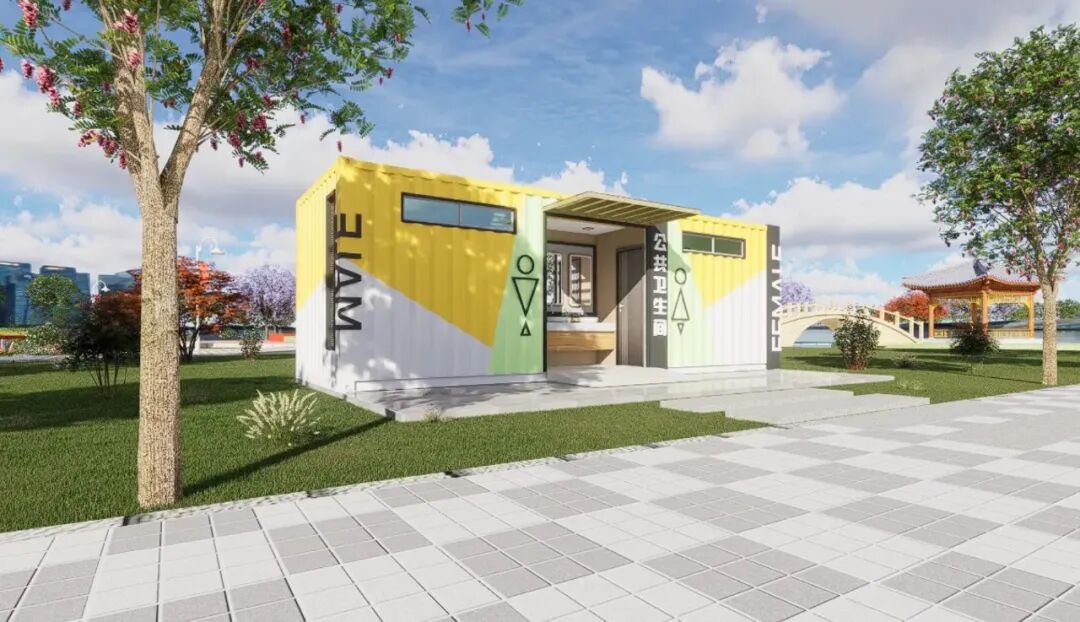
Abandoning the rough and single design of traditional temporary toilets, modern container toilets focus on both practicality and user experience. They are fully equipped with automatic flushing toilets, integrated hand washing tables, professional ventilation and deodorization systems and LED lighting systems, maintaining a clean, dry and odor-free sanitary environment all the time. While meeting basic toileting needs, they greatly improve the comfort of public sanitation services. Moreover, the flexible and diverse appearance design allows container toilets to match various urban styles and scenic themes. With customized color matching and decorative design, they can be integrated into urban landscapes naturally, becoming unique decorative art facilities in public spaces and enhancing the overall urban image.
5. Excellent Disaster Resistance and Emergency Support Capacity
The integrated steel structure of container toilets endows them with strong structural stability and impact resistance. Unlike traditional fixed toilets that are easy to collapse and damage in natural disasters such as earthquakes, floods and typhoons, container toilets can maintain complete structural integrity in harsh environments. Relying on their rapid transportation and quick deployment characteristics, they can be delivered to disaster-stricken areas at the first time to provide stable and clean temporary sanitation facilities for disaster-affected people and rescue workers. This effectively avoids the spread of bacteria and infectious diseases caused by the lack of sanitation facilities after disasters, makes up for the shortcomings of urban emergency public health support, and comprehensively improves the city’s disaster prevention and emergency response capabilities.
Conclusion
In summary, container toilets stand out from traditional sanitation facilities with their flexible deployment, green environmental protection, modern service, low maintenance cost, customizable performance and emergency disaster resistance. They provide efficient, economical and sustainable sanitation solutions for urban daily operation, temporary event guarantee and emergency disaster relief. As global urbanization continues to advance and public environmental and service standards keep improving, modular container toilets will gain broader application prospects, helping create cleaner, more convenient and livable modern urban public environments.
Products Category
Latest News
CONTACT US
Name:
Mobile:+86-13222235952
Tel:+86-13222235952
Email:sales@to-rail.com
Add:Room B1701, Building 4, Dongfang Xintiandi, Yangshe Town, Zhangiiagang City, Suzhou City. Jiangsu Province, China, Zipcode:215617