Industry news
The Evolution of Toilets on China’s Passenger Trains
The Evolution of Toilets on China’s Passenger Trains
The United Nations General Assembly adopted a resolution in July 2013, designating November 19 as World Toilet Day. The observance highlights the sanitation crisis faced by disadvantaged communities worldwide. It aims to advance access to safe drinking water and basic sanitation facilities, advocate for a clean, decent and hygienic environment for all, and galvanize global efforts to improve public sanitation. Small as it may seem, the toilet mirrors people‑centered wellbeing. The evolution of onboard toilets on China’s railways serves as a vivid testament to China’s progress in sanitation and passenger services.
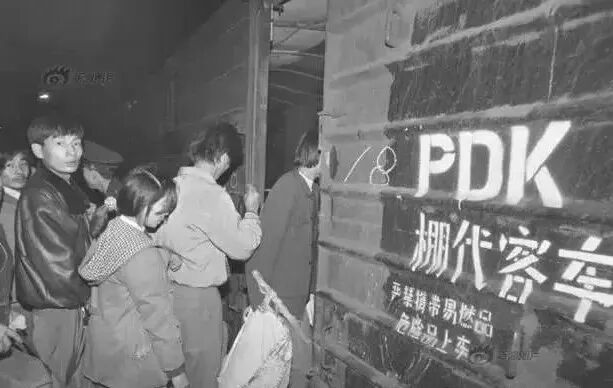
Back in the 1970s and 1980s, railway passenger capacity fell far short of demand. During the Spring Festival travel rush, freight boxcars were temporarily converted into makeshift passenger carriages, known as “peng‑dai‑ke”. Toilet facilities were extremely rudimentary. Some converted carriages had a simple toilet at one end. In others, a wooden barrel was placed in a corner, with a hole drilled at the bottom. Straw mats and bamboo boards formed a flimsy partition. Human waste dropped straight onto the railway tracks, resulting in appalling sanitary conditions for travellers.
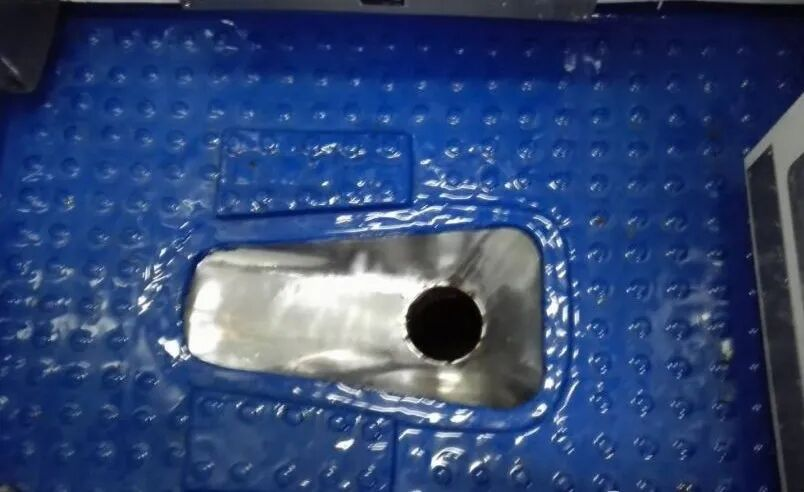
In the 1990s, massive railway equipment upgrades phased out these makeshift freight‑turned‑passenger cars. Large numbers of green‑skin trains came into service, fitted with direct‑discharge toilets. These featured ceramic bowls set in steel floors, with outlets opening directly to the tracks. Waste was flushed onto the roadbed, causing pervasive stench along rail corridors and creating nuisances for local residents and track maintenance crews. Regulations required attendants to lock the toilets whenever stops exceeded three minutes, leaving passengers in urgent need with no access.
Today, conventional passenger trains operate with both direct‑discharge toilets and vacuum holding toilets, which fall into two categories: vacuum‑retention type and vacuum‑on‑line type. Vacuum toilets are simple‑structured, user‑friendly, water‑saving and easy to maintain. Conventional trains also feature spacious accessible toilets for passengers with disabilities, designed for wheelchair access and fitted with handrails and wash basins, winning positive feedback from travellers. In recent years, onboard sanitation has further improved: restrooms are fitted with taps, wash basins, deodorant balls, waste bins and paper dispensers. Net pockets on doors hold personal bags. Adjacent wash areas provide hand soap, towel racks and mirrors.
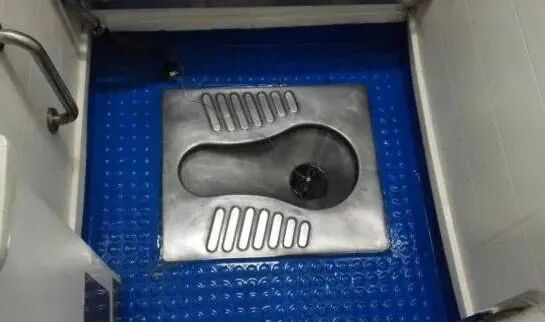
Poor toilet conditions were not unique to trains at that time. Public toilets across society were generally dirty and smelly. Foreign visitors once commented: “China excels at ‘input’, but its ‘output’ facilities leave much to be desired.” The remark laid bare the underdeveloped state of public sanitation infrastructure. By the late 1990s, toilet bowls were replaced with hard plastic‑steel materials for better durability and ease of cleaning. Nevertheless, waste was still discharged directly onto tracks; the fundamental environmental problem remained unsolved.
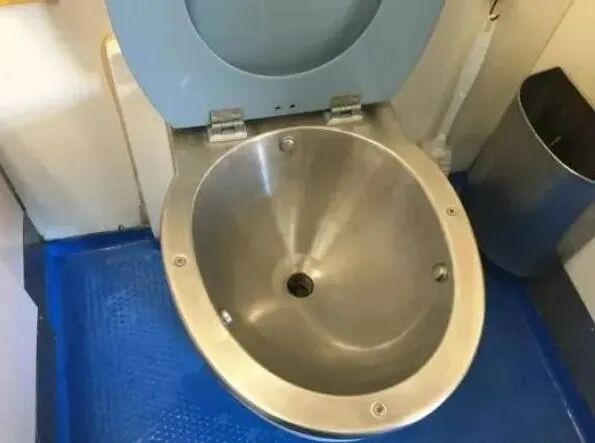
At the turn of the century, new passenger rolling stock including Type 25K, 25G and 25T carriages entered operation, equipped with vacuum waste collection systems. Each carriage had an independent vacuum toilet unit paired with 550‑litre waste tanks at both ends, sufficient for 36 hours of continuous service. Integrating mechanical, electrical, pneumatic, hydraulic and vacuum technologies, the system released a small volume of water upon button activation. Powerful vacuum suction drew waste and odour into under‑carriage holding tanks. Waste was pumped out by dedicated sewage vehicles at terminals. Trains no longer discharged waste onto tracks.
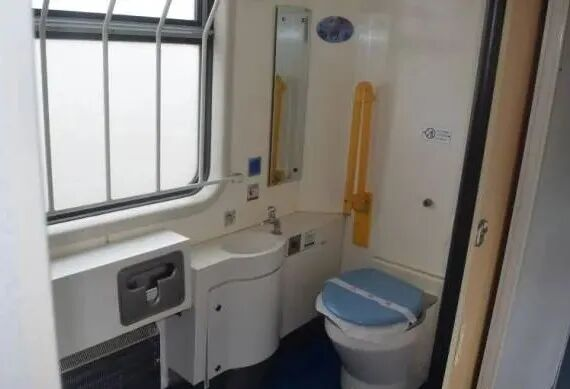
With the wide deployment of Hexie (Harmony) EMUs, train sanitation advanced by leaps and bounds. Every carriage is fitted with EMU‑specific waste collectors of 770‑litre capacity — 40 % larger than those on conventional carriages. EMU restrooms offer both squat and sitting toilets to accommodate different personal habits. Two mirrors help passengers tidy their appearance. Sensor‑operated wash basins come with hand soap, paper towels and bins. Waste is extracted by central suction pumps at terminals for harmless disposal. Toilets stay available both while running and at stations.
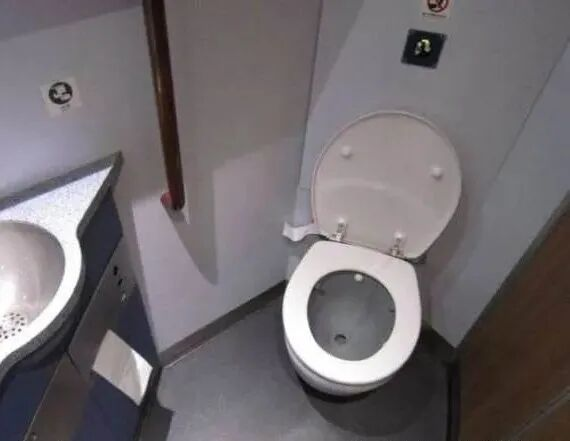
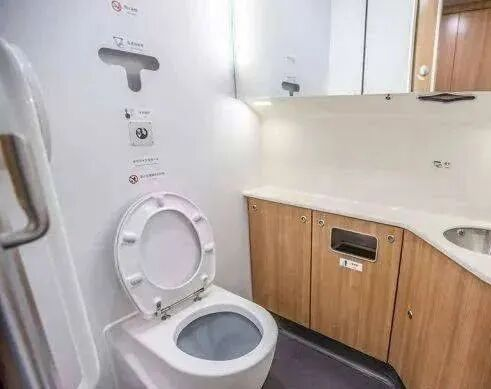
Fuxing (Rejuvenation) EMUs build on this foundation. Their accessible toilets are even more spacious. Constructed with glass‑reinforced plastic and finished with marble countertops, they are equipped with delayed‑action water valves, flush valves and emergency call buttons, offering ample manoeuvring space for wheelchairs. Fuxing restrooms add baby‑changing tables and fold‑down handrails for families with infants. Where Hexie uses manual toilet doors, Fuxing adopts automatic doors with eye‑catching coffee‑wood‑grain control buttons. Toilets in business‑class compartments are more spacious and comfortable.
Over the four decades of reform and opening‑up, train toilets have evolved from crude barrel‑based arrangements in converted freight cars, through direct‑discharge units on green‑skin trains, to vacuum collection systems on air‑conditioned carriages, and further to highly human‑centred facilities aboard Hexie and Fuxing high‑speed trains. Rising technical sophistication and continuously improved hygiene deliver a pleasant travel experience. The transformation of this small but essential facility reflects the dramatic development of China’s railways and remarkable achievements in public transport services, aligning perfectly with the vision of World Toilet Day: clean sanitation for all.
Products Category
Latest News
CONTACT US
Name:
Mobile:+86-13222235952
Tel:+86-13222235952
Email:sales@to-rail.com
Add:Room B1701, Building 4, Dongfang Xintiandi, Yangshe Town, Zhangiiagang City, Suzhou City. Jiangsu Province, China, Zipcode:215617